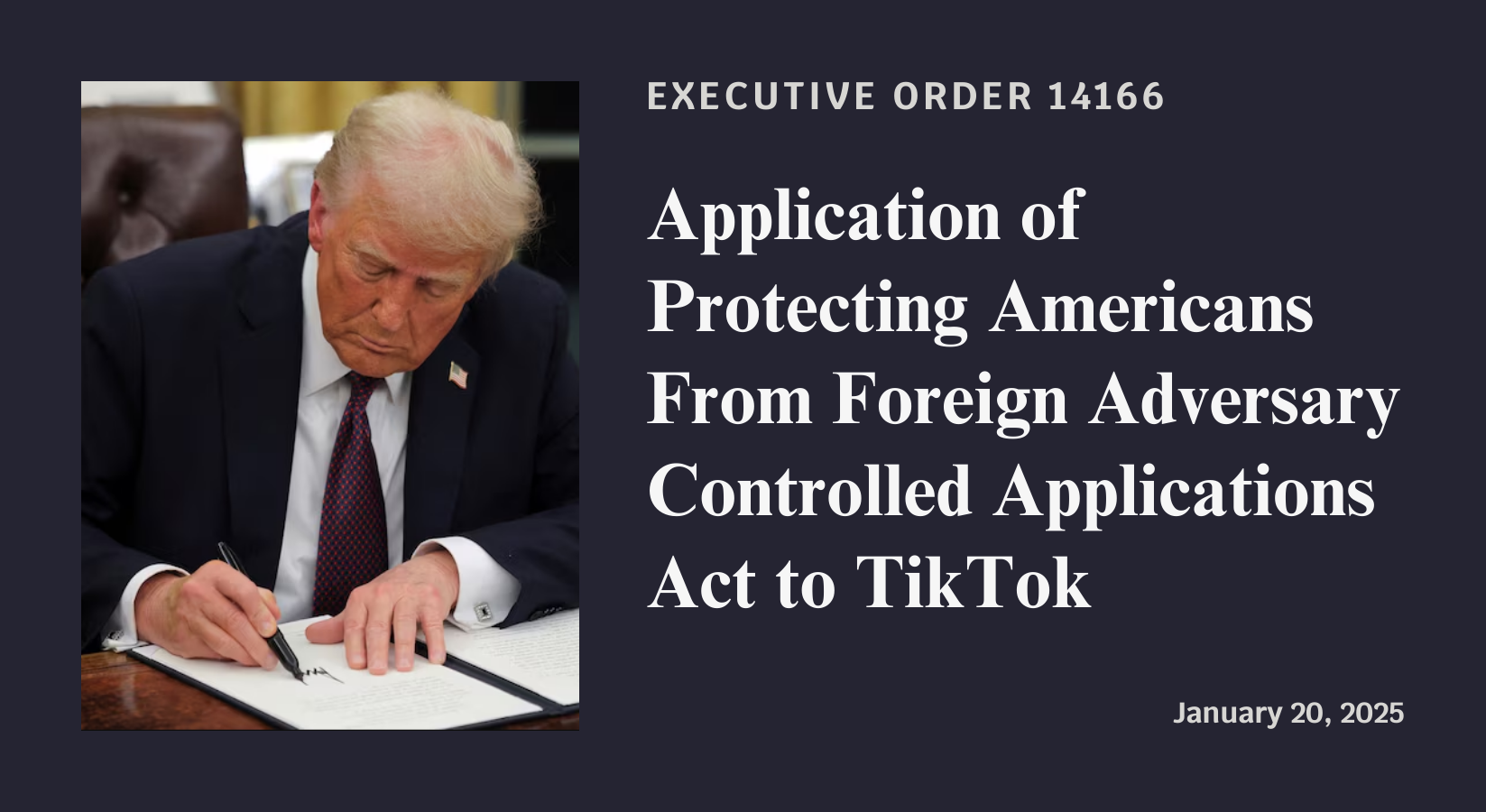
Executive Order 14166
Application of Protecting Americans From Foreign Adversary Controlled Applications Act to TikTok
Signed on January 20, 2025
On January 20, 2025, President Trump signed Executive Order 14164, which delays enforcement of the Protecting Americans from Foreign Adversary Controlled Applications Act against TikTok for 75 days. The order instructs the Attorney General not to pursue penalties or enforcement actions during this period to allow the administration time to review national security concerns, examine mitigation measures, and seek a possible resolution that protects both security interests and the rights of the 170 million Americans who use the platform.
🔗 Read the Executive Order on the Federal Register
🔗 Read the White House Announcement
What You Should Know
This order temporarily prevents an immediate nationwide TikTok ban.
The Protecting Americans from Foreign Adversary Controlled Applications Act went into effect on January 19, 2025, one day before Trump returned to office. Without this order, the law would have forced app stores and hosting services to block TikTok immediately. By pausing enforcement for 75 days, the administration has created time to evaluate national security concerns while avoiding a sudden loss of access for millions of users.
National security concerns are centered on TikTok’s parent company, ByteDance.
Lawmakers argue that ByteDance, a China-based company, could be compelled to share user data with the Chinese government under Chinese national security laws. These fears include possible surveillance, propaganda, and influence campaigns targeting American citizens. TikTok has stated that it stores U.S. user data domestically and has attempted to establish independent U.S. operations, but questions remain about how effective these protections are.
Free speech and censorship concerns are at the center of the debate.
TikTok has become a major platform for political expression, small business advertising, and community-building. An abrupt shutdown could limit Americans’ ability to communicate and organize online, raising First Amendment questions. Courts have previously blocked executive attempts to ban TikTok on similar grounds, warning against government overreach in regulating speech platforms.
This order shields companies from liability during the pause.
The order directs the Attorney General to issue guidance and letters to providers such as Apple, Google, and internet hosts, confirming that they will not face penalties for continuing to distribute or support TikTok during the 75-day suspension. This protects companies from lawsuits or fines as the administration negotiates next steps.
State-level attempts to enforce the law are blocked.
The order explicitly states that enforcement authority rests solely with the Attorney General. By doing so, it prevents states or private parties from trying to impose their own bans or penalties, ensuring TikTok’s fate is determined at the Federal level only.
Who Wins?
TikTok and its U.S. users
The pause allows TikTok to remain available to its 170 million American users while the administration explores alternatives to an outright ban. This benefits content creators, businesses, educators, and everyday people who rely on the platform for income, communication, and outreach.
App stores and internet service providers
Companies like Apple, Google, and major web hosts are relieved from legal uncertainty and penalties during the suspension. They are able to continue offering the app without fear of lawsuits or government fines, giving them stability while the review process unfolds.
Advocates of free speech and digital rights
Civil liberties organizations have raised alarm about broad bans on social media platforms, arguing they violate free expression protections. The pause gives these groups more time to press their case and seek stronger legal protections against overreaching bans.
Who Loses?
Lawmakers pushing for an immediate ban
Some members of Congress who championed the Act wanted a swift removal of TikTok from U.S. networks. By halting enforcement, this order delays their preferred outcome and raises the possibility of a negotiated settlement instead of a full ban.
U.S. national security hardliners
Officials who argue that TikTok is a direct threat to national security see this pause as giving ByteDance more time to strengthen its legal and business defenses. They worry that delaying enforcement could leave American data vulnerable while risks are assessed.
Competing social media companies
Platforms like Instagram, YouTube Shorts, and Snapchat might have benefited from TikTok’s abrupt removal, gaining millions of displaced users. With TikTok still online, their opportunity to quickly dominate the short-form video space is stalled.
This executive order represents a temporary truce in the battle over TikTok’s future in the United States. It does not resolve whether the app will be banned, forced to sell to an American company, or allowed to continue under new security conditions. Instead, it creates breathing room for review and negotiation. The outcome will shape not only how Americans use social media but also how the government balances free speech, national security, and international business competition in the digital age.
Take Action
Stay informed about the legal and security debate.
Much of the controversy around TikTok involves technical details about data storage, cybersecurity, and foreign law. Research reliable sources, follow updates from digital rights groups, and avoid misinformation that oversimplifies the issue into partisan talking points.
Support organizations defending free speech online.
Groups like the Electronic Frontier Foundation (EFF) and the ACLU are working to ensure that national security concerns are addressed without undermining First Amendment rights. Supporting their efforts helps protect broader internet freedoms beyond TikTok itself.
Pay attention to how your representatives handle tech policy.
The future of TikTok will likely involve congressional input, whether through amendments to the Act or through new legislation on data privacy and foreign-owned apps. Contact your representatives and let them know whether you support strong privacy protections, a regulated sale, or opposition to broad bans.
The debate over TikTok highlights how easily misinformation spreads and how quickly fear can be used to justify broad restrictions on speech. Always fact-check claims, seek multiple credible sources, and be cautious of narratives designed to stir fear rather than provide evidence. The choices made now will shape not just TikTok, but the future of internet freedom in America.