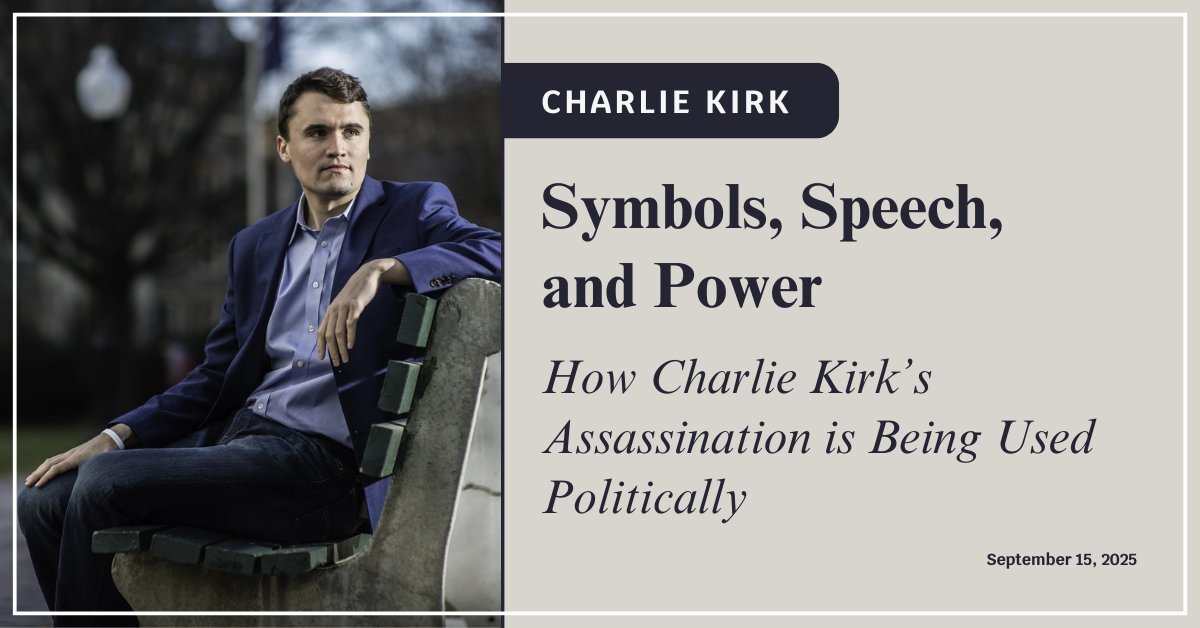
On September 10, 2025, Charlie Kirk was shot and killed while speaking at Utah Valley University. His death shocked the country and quickly became the focus of national attention; and, within hours, the tragedy has turned into a political story. President Donald Trump ordered that flags across the nation be lowered to half-staff until September 14. Kirk’s body was transported with a military escort, and Vice President J.D. Vance flew on Air Force Two to take part in the mourning ceremonies. For many Americans, these acts of tribute seemed appropriate for a man who was an influential conservative voice. For others, they raised questions about whether national symbols were being used fairly or whether they had been turned into partisan tools.
The lowering of flags in Kirk’s honor was particularly striking because it broke from tradition. Normally, this practice is reserved for presidents, governors, members of Congress, decorated military service members, or others who held official roles in government or public service. Kirk was a private citizen. He had never served in the military, never held elected office, and never officially worked in government. His influence came through his activism and his commentary, especially his role in promoting the MAGA movement. To extend this honor to him signaled a major shift in how symbols of national mourning are applied. Many observers could not help but wonder whether a figure on the opposite end of the political spectrum, no matter how well known, would have received the same treatment.
The military escort for Kirk’s body made this even clearer. Such ceremonies are usually reserved for those who served their country in uniform or in public office. In Kirk’s case, his body was accompanied with the trappings of state honor despite his lack of military service. This blurred the line between civilian figures and national heroes. It gave the impression that Kirk’s political alignment with Trump’s movement was enough to grant him the same recognition given to those who sacrificed their lives in defense of the country. This use of military symbolism is part of a broader pattern where armed forces imagery is used to legitimize political figures who did not serve but who embody the values of one political side.
Even as the government organized these displays of mourning, many ordinary people found themselves punished for how they reacted to Kirk’s death. In the days that followed, employees at companies, universities, and news outlets lost their jobs or faced suspension for comments they made online. Some of those comments were celebratory, but many were not. In some cases, people simply criticized Kirk’s legacy or questioned the extraordinary attention his death was receiving. In one prominent example, political commentator Matthew Dowd was fired from MSNBC after suggesting that hateful rhetoric can create conditions that lead to violence. Elsewhere, individuals who made more mild remarks found themselves named on social media, harassed, or threatened. Conservative activists even began circulating the identities of people who expressed views out of line with the mourning narrative, leading to real fears of retaliation. This atmosphere created a chilling effect. Many people who did not share the dominant view felt it was safer to stay silent than to risk losing their jobs or being publicly shamed.
At the same time, Republican leaders rushed to frame the assassination as a political act by the so-called radical left. Trump and other figures declared that Kirk’s murder was the result of hatred stirred up by their opponents. Yet investigators have not confirmed that the suspect acted out of political ideology. While reports have noted threats and troubling writings from the accused shooter, no clear evidence has tied his actions to an organized political movement. Even so, the speed with which responsibility was placed on one side of the political spectrum shows how tragedies are often seized upon as opportunities to attack opponents. Mourning was quickly linked to blame, and anyone who refused to accept this framing risked being accused of insensitivity or even complicity.
The use of state symbols and the silencing of dissenting voices reveal a troubling trend. When flags are lowered, military honors granted, and punishments handed out based on political alignment, the meaning of these acts shifts. What were once signs of national unity begin to look like partisan statements. If a conservative commentator can be honored in this way, while others who die violently receive no recognition, the message is that some lives are considered more valuable to the nation than others. When jobs are lost and speech is punished simply for criticizing a public figure, the boundaries of free expression are narrowed. And when whole groups are blamed for the actions of one person, the risk of further division and violence grows.
It is important to remember that Kirk’s death was tragic. A man lost his life, leaving behind a grieving family, friends, and supporters. Condemning political violence should be a point of agreement across society. But recognizing the tragedy does not mean ignoring the troubling ways it has been handled. Respect for the dead does not require silencing the living. It is possible to condemn the act of violence without agreeing with the politics of the victim, and it is possible to mourn while also questioning the use of state power and symbols in response.
The aftermath of Kirk’s assassination shows just how fragile American civic life has become. Mourning was quickly politicized. Symbols of unity were used in a partisan way. Free speech came under pressure, and blame was cast before facts were confirmed. These choices matter because they shape the future. If this becomes the standard—where state honors are extended only to those in power’s good graces, where speech is punished for failing to match official narratives, and where tragedy is immediately weaponized against opponents—then the nation risks losing the very principles of fairness and open debate that democracy requires.
In the end, Charlie Kirk’s death revealed not only the danger of political violence, but also the danger of what comes after. How the country chooses to mourn, whose voices it allows, and what symbols it elevates will shape more than the memory of one man. It will shape the identity of the nation itself. The challenge is whether Americans can find a way to honor the dead while protecting free speech, ensuring fairness, and keeping national symbols from becoming partisan trophies. If they cannot, then this moment of grief will leave behind something even more damaging than the loss of a single life.