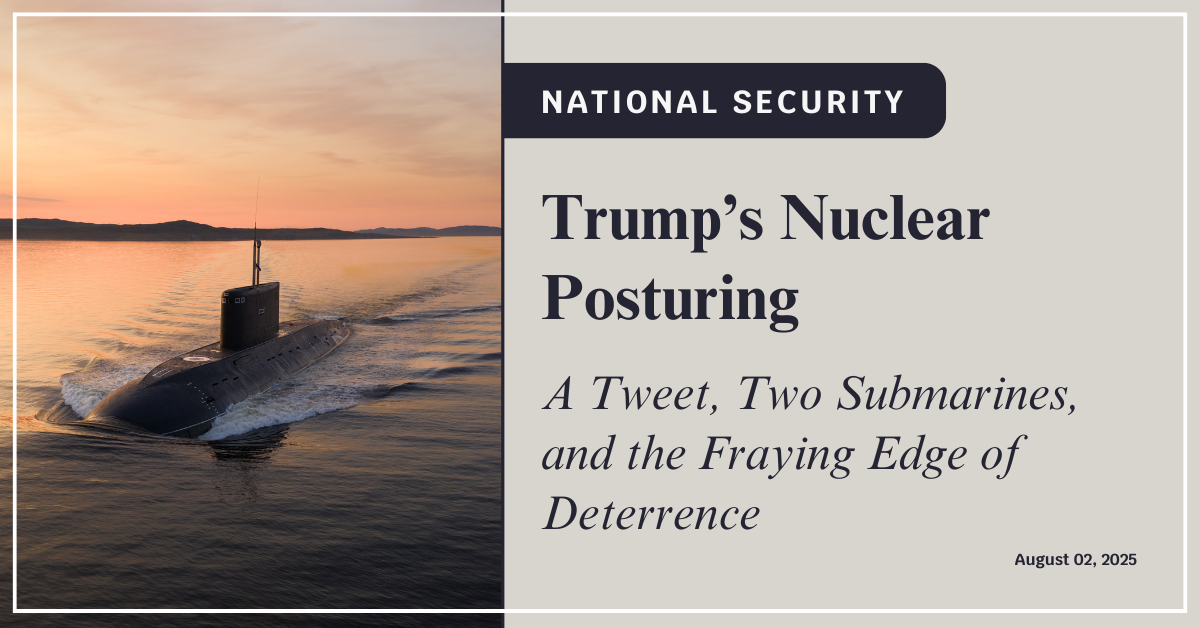
On August 1, 2025, President Donald Trump announced on Truth Social that he had ordered the repositioning of two United States nuclear submarines in response to an online statement by former Russian president and current Security Council deputy chairman Dmitry Medvedev. Trump’s message declared that “words are very important, and can often lead to unintended consequences,” presenting his decision as a precautionary step. In reality, the move marked one of the most provocative and unrestrained uses of nuclear signaling in modern American history.
The events began on July 28, when Medvedev issued a warning on social media telling Trump that his ultimatums toward Russia risked escalating not only the war in Ukraine but also a wider conflict with the United States. Medvedev is known for his fiery rhetoric, and many international observers regarded his post as more bluster than policy. Trump, however, did not treat it that way. Instead of ignoring or downplaying the message, he chose to respond by announcing the movement of the country’s most sensitive and secretive nuclear weapons platforms.
This announcement broke with decades of nuclear doctrine. The United States has long relied on submarines as the most secure part of its nuclear arsenal. Their strength lies in their invisibility, which guarantees a second strike capability and deters any adversary from attempting a first strike. By publicly declaring their repositioning, Trump undermined that strategy. He turned what had always been a silent and carefully managed system into a piece of political theater played out on social media.
The response at home and abroad was immediate. Pentagon officials, speaking through anonymous sources, suggested they had not been consulted before the announcement, raising questions about whether normal chains of command had been followed. In Europe, NATO allies voiced unease at being excluded from a decision that directly affects the alliance’s nuclear posture. Russia mocked the move as provocative and childish, while China urged all nuclear powers to exercise restraint. Prominent European newspapers described the decision as destabilizing, warning that the United States had entered a dangerous era in which nuclear diplomacy is driven by the personality of its leader rather than careful strategy.
The risks to national security are serious. Nuclear deterrence only works when it is steady, predictable, and rooted in rational behavior. When a president suggests that a foreign tweet is grounds for nuclear movement, the boundary between personal insult and national threat begins to collapse. That blurring of the line increases the danger of miscalculation. An adversary who does not know whether threats are symbolic or real might respond with heightened readiness, military action, or even preemptive force. History shows that wars involving nuclear powers are most often sparked not by deliberate first strikes, but by missteps and misunderstandings in times of crisis.
This incident also reveals how fragile institutional checks on nuclear authority have become. Congress has little power to oversee or restrain a sitting president’s nuclear decisions. The courts have no formal role in such matters. The Department of Defense, at least in public, offered no clarification or correction of Trump’s order. Civil society groups criticized the announcement, but without legal tools to force restraint, their influence is limited. The result is a situation in which the most destructive weapons on earth are, in practice, subject to the will of one man.
The consequences abroad may be longer lasting than the immediate drama of Trump’s post. By tying nuclear weapons to personal ego and political messaging, he has weakened the confidence of United States allies, emboldened adversaries, and eroded the global taboo against casual nuclear threats. If this precedent stands, the threshold for actual nuclear use will continue to fall. Analysts warn that tactical nuclear weapons, which are smaller and more likely to be used on battlefields, could one day be employed in conflicts involving Iran, Ukraine, or Taiwan. The taboo that has held since 1945 was always fragile, and it is now being chipped away in plain sight.
The submarines themselves may or may not have moved. That detail matters less than what the announcement represents. The president of the United States has taken the most fearsome element of the country’s military strength and used it not to respond to an imminent threat, but to score points in a rhetorical battle. Once nuclear weapons are treated as tools for spectacle rather than survival, the pathway to their use becomes shorter and more dangerous. The world is left to wonder whether restraint will hold the next time an insult, a tweet, or a political provocation tempts the president to reach for the nuclear arsenal.